building with ai is costly
exactly how i wanted to spend my saturday evening
Artificial intelligence may, on balance, cost more than it is worth in any sense relevant to the people who build with it. The diagnosis offered five years ago in On the Dangers of Stochastic Parrots survives contemporary release cycles substantially intact, in that the systems on offer in 2026 are, for most non-coding workloads, fluent in proportion to how confidently they are wrong, and even on the coding workloads where they earn their keep, they are now mired by rate limits, deprecation cycles, and unilateral pricing revisions that make any production dependency on them a load-bearing risk.
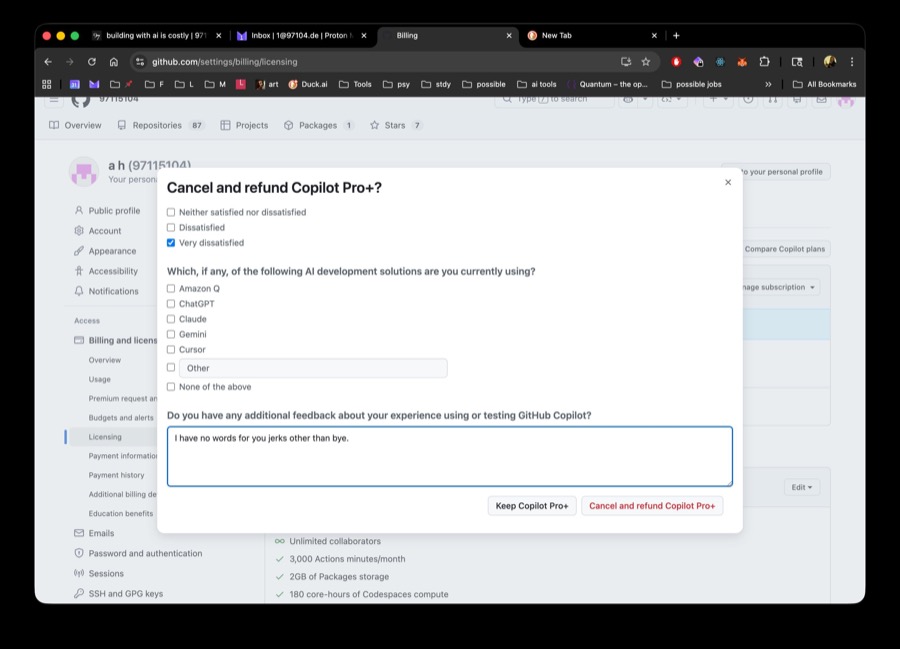
I am writing this on the same evening I hit 90% of my weekly Claude rate limit. A limit that Copilot introduced only last week in the latest VS Code update without notice. I got said notice in the middle of a project, at 5:00 PM on a Saturday, with the reset clock (when I can use the model(s) again) set for the same time tomorrow. This story of unannounced rate-limiting has happened so many times that I am now at my wit’s end. I am writing this blog post because the interaction with Copilot that consumed all those tokens I eventually had to throw out; three times it produced unacceptable slop to the point that my time was better spent closing my laptop, walking to the other room where my gaming desktop sits and spending it writing this blog post, as has happened so many times before, if the end of writing code and the beginning of directing it is any evidence. Out of curiosity, I investigated the actual cost of the requests I put through now that Claude 4.7 is 150% more expensive than it was before and found that I spent exactly $21.56 for the day in Copilot premium requests alone, with a further $5.40 spilling onto the following day’s bill (tomorrow), for a running total of $26.96.
Most of the above probably comes as no surprise to others building with AI tools, because unfortunately it’s now the norm of what is required in order to develop software, and further, this “type” of development is now somewhat maligned as “vibe coding” which, ultimately, makes no sense, unless those who force the term are deploying it as a special skill, of which it is, because working with AI tools is just easy enough to feel like dealing with a confidence man, and just troubling enough that it feels like you’re being somehow manipulated in the process and then paying for the pleasure.
The New York Times has lately taken to calling this concept of maximizing out rate limits as “tokenmaxxing”, reporting in March 2026 that a single Anthropic user of Claude Code billed more than one hundred and fifty thousand dollars in a single month. The paper’s opinion desk has separately framed it as a developer-burnout story. Both pieces tell the same story of working with AI tools to a level that is unhealthy and often counterproductive.
What follows is a somewhat long-winded instrument of rant detailing my experience using AI tools, which has culminated in my decision, as it stands today, but will probably change tomorrow, to stop using them as a primary driver of development, preferring to return to the days where Google, StackOverflow, and my hugely heavy Python textbook were the extension of my development knowledge, at least then I won’t be rate limited…
models only sometimes listen
As usual, I started my work day, yes on a Saturday, walking over to my computer and opening up VS Code. The night before I had finished writing a very long 20 or so page paper about AI and data called The Human Data Collective, and realized, through my sleep, that it was overcomplicated. So in an effort to simplify it, I decided to break it into three separate ideas and publish them individually. To execute the task, I sent through four sentences of prose as a prompt that, in my view, left no room for error and was entirely unambiguous. The prompt detailed how to split one of my papers into three separate documents, outlining what each of the three documents would cover in detail, and gave clear instructions of what to remove, paying specific attention to preserving the writing style and quality I had spent so many hours developing in the original paper. Hopefully because I have experience with these tools not being able to produce writing of any quality at all. They are literally trained to use a baseline of creative style mostly consisting of em dashes, antithetical constructions, lists, and tables, in order to keep people interested, seem smart, and not overcomplicate things, but that results in subpar, often useless text most people now call slop. To my dismay, the new Opus 4.7 model was just like its predecessor, despite the 150% increase in cost, and maybe even somewhat worse, at the task at hand.
What the model produced, in response, was a two-column layout, a regenerated attestation table populated with fabricated identifiers, eighteen appearances of the “rather than” phrase it loves so much in three documents alone, and a roughly thirty-thousand-token deduction from my weekly rate budget for the privilege. When I expressed my amazement at the low quality and provided several targeted enhancements, Claude apologized, repaired two of the three original defects, broke a fourth thing entirely outside the scope of the original request, and asked, in the same closing line, whether I would like it to continue. I said no, and, as I mentioned earlier, decided to write this post.
The lesson taken from enough turns of this kind is that the proposition a model “listens” is, at best, a property of the moment, contingent on the specific shape of your request, how you tokenize your prompt, the breathing room of your given context window, the most recent round of fine-tuning, any system prompt held back from view (where terrible horrible slop style comes from), the rate limiter that is about to throttle you, and whatever else is happening on an inference cluster about which you have no visibility, with the consequence that some iterations yield workable output while others yield drivel sufficiently off-target that you pay for the misfire, pay a second time for the conversation that explains the misfire, and pay a third time for the regeneration that, if you are fortunate, lands somewhat closer to your original goal.
this one is not new, but still a real problem
A hallucination, in the technical sense relevant to anyone building software on top of an AI workflow, is the production of a phrase that is spelled correctly, parses correctly, and is factually false, generated with no internal mechanism in the architecture by which the model could detect or signal that it has made something up, because there is no part of its underlying technology (transformer language model) that distinguishes the operation of retrieving a fact from the operation of sampling a plausible continuation from a learned conditional distribution, the two are the same arithmetic over the same weights, and the model has no privileged access to the world against which it could check the result before emitting it.
Translated for a reader whose work lies outside engineering, the consequence is that any request put to a model such as a court case, an API endpoint, a function signature, a person’s job title, a date of birth, or a bibliographic citation, returns a phrase that is well-formed, correctly punctuated, and plausible on its face, generated by the same tools and with the same confidence regardless of whether the underlying referent exists in the world, with the further consequence that a real citation and an entirely fabricated one are, to the model and to any downstream system that lacks a separate verification step, indistinguishable. The Manhattan attorney sanctioned in Mata v. Avianca in June 2023 for filing a brief that cited six entirely fabricated cases generated by ChatGPT is the canonical example of this hazard escaping the laboratory and arriving in front of a federal judge.
A pipeline that takes model output as authoritative absent an explicit verification step that consults the real source will publish fabrications at the model’s hallucination rate multiplied by the throughput of the pipeline, and that rate sits well above zero, with internal frontier-lab testing reported in Karen Hao’s Empire of AI putting an early version of GPT-4 at roughly thirty percent on closed-domain prompts and with recent peer-reviewed work by Kalai et al. showing formally that under standard pretraining and reinforcement-learning-from-human-feedback objectives the models are statistically incentivized to guess, and so this remains a structural property of the architecture inherent to the way these systems are built, with the mitigation in every case being the verification step itself, namely the human labor that the technology was, on its marketing surface, sold as eliminating.
Put most simply, AI tools make shit up around 30% of the time, and regardless of the quality of a response, you have to pay for it. No other system or service has rates even close to AI tools in terms of “hallucinating” material, and my most recent experience is a clear example of that. There’s lots of evidence explaining the dangers of “hallucinations” or making shit up, all the while the largest frontier providers seem to do nothing about it other than increase your bill and spread culpability to you and other users, like the lawyer who probably lost their license.
exacting payment regardless
Tonight’s session cost me, in token-denominated terms, roughly the same whether the model produced something I could use or whether it produced something I had to discard and regenerate three separate times, because the meter used in my current favorite flavor of inference provider, VS Code, is denominated in tokens consumed and contains no gate for usefulness, with the consequence that two thousand words of confidently wrong prose bill at the same rate as two thousand words of something usable, even more distressing, any corrections or suggestions are billed at the same rate, same with a regeneration request to retry hoping for a better result, and then there’s the time you spent making those changes and suggestions when the whole point was to save time to begin with followed by the anxiety you’ll have to double, triple, or start over from scratch when results are as inconsistent and unreliable as they have come to be.
I struggle to identify another professional service permitted to price its output this way, in that a lawyer who drafts the wrong brief is barred from billing for the wrong brief, billing again for the meeting in which the brief is established to be wrong, and then billing a third time for the corrected brief on a single line item without disclosure, and a contractor who frames the wrong wall absorbs the cost of the wrong wall and takes it down at their own expense, whereas the present billing convention for inference covers the wrong wall, the conversation in which I explain that it was the wrong wall, and the construction of the right wall, with the invoice declining to distinguish among the three.
Wasn’t ^ ridiculous? My point exactly. These kinds of “hallucination” problems with a bill attached just do not exist in the real world and are straight-up crazy.
The defense offered, when one is offered at all justifying shipping a half-baked product and charging for its errors, is that the model has no internal mechanism by which to determine whether the output it produced was useful, and that defense is, on its own terms, true, and is therefore also an admission that the product is sold without a quality guarantee, a posture that any other industry shipping under the same conditions would be required to disclose prominently and that this one buries under benchmark scores reported on tasks distinct from the task you are paying it to perform. Examples of these “benchmarks” include things like GPT-5’s recent system card.
Sure, the main providers do “warn” you with a footer sentence at the bottom of their interfaces saying “ChatGPT can make mistakes. Check important info.” or “Gemini is AI and can make mistakes.” or “Claude is AI and can make mistakes. Please double-check responses,” but what about actually taking accountability for the problem and designing it differently to address the challenges of using the tool you are asking your customer to pay for? I don’t understand exactly why, but for some reason AI tools have this quality almost like FOMO, but also like other kinds of “addictions” which persuade you passively to keep going, spend just a little more time and you’ll get what you were hoping for, just a few more tokens and you’ll have that feature, upgrade to max and you’ll have 10x the limits…eventually it’ll be something like, hand over your paycheck and we’ll kind of remove rate limits, actually, wait, that’s already what they do with per-token billing. I digress. Moving on to rate-limits…
rate-limits are an anxiety-ridden norm that will be a new therapy staple
If the present trajectory holds, I have come to believe, the next decade will produce sufficient demand for a clinical specialty addressed specifically to engineers, designers, writers, and other knowledge workers whose livelihoods are mediated through frontier inference endpoints that retraining as a therapist would, on a strictly mercenary reading of the labor market, be a more defensible career move than continuing to build on top of the endpoints themselves.
A pattern that produces the harm that would necessitate these therapy visits is structurally consistent across chat sessions, namely the accumulation, over the course of two or three hours but often many more, of a context window populated with the right files, numerous iterations, and a debugging trajectory that has narrowed to within one or two prompts of a working build, followed by the return of a rate limit error against a reset clock measured in tens of hours, with the partially completed work then stranded inside a chat surface closed to you or your colleagues, atop a context window unreachable from the outside, and with the portion of the work that is now blocking forward progress being precisely the portion that was delegated to the model in the first place, leaving no productive action available except waiting.
After explaining the above pattern, what is a therapist to do? Pull out GPT and ask? Probably the way things are currently going. Actually, your therapist is probably ChatGPT. If that’s true, be warned, many people have rued the day… a good therapist would just advise not using AI altogether, and that’s at least what I would advise if I heard a third party tell me that.
The arrangement that has become using AI tools is, on a clinical reading, a slot machine wired to the user’s bank account, in which the reset clock supplies the cooldown, the next prompt supplies the pull, the variability of the model’s response supplies the variable reward, and the broader engineering profession finds itself, more or less voluntarily, occupying the experimental enclosure that operant-conditioning research originally designed for laboratory rodents.
Clinical literature has, in the meantime, caught up to the more severe end of the AI product surface problems, coming back to my point about the fact GPT probably is your therapist. Notably, the 2024 case of Sewell Setzer, the fourteen-year-old in Florida whose mother filed suit against Character.AI following his death by suicide, the 2023 case of the Belgian man who ended his own life after several weeks of conversation with an Eliza-class chatbot, and the early case-study literature on what clinicians have begun to refer to as parasocial artificial intelligence dependency.
While I draw a firm line between those instances and harms and the inconvenience followed by anxiety produced by arbitrary rate-limits, I am pointing out that the same AI products produce a full distribution of real problems any psychiatrist or therapist would be paid many hundreds of dollars to address and that the AI industry’s response has, in each instance, been to ship the next model, maybe update a safety page, and continue.
pricing is a rat race and there is no backup for quality deprecation
The headline per-token price of frontier inference has fallen by roughly an order of magnitude per year for three consecutive years, and the headline figure, taken on its own terms, is accurate according to Epoch AI and similar, but what the figure obscures is that the cheaper price is for a different underlying model, the model on which a given product was built last quarter has by this quarter been deprecated, the endpoint to which the API now resolves behaves differently on the same prompts, and the resulting regressions appear in no changelog because the changelogs are written against benchmark deltas and the prompts that constitute a working production system sit entirely outside the benchmarks the changelog reports against, and always have.
There is, in practice, no mechanism by which a downstream customer can pin a model, in the sense that some vendors do publish dated snapshots and then deprecate those snapshots on a six-month cycle, with the consequence that the specific version of the system on which a given product was built will reliably cease to be available before that product has reached anything resembling commercial steady state, and the migration to the replacement model will require the re-evaluation of every prompt template, output parser, and test fixture that was written against the prior generation, with that work falling entirely on the customer, appearing nowhere in the per-token line, and recurring on a roughly two-quarter cadence indefinitely.
Each frontier provider is now running a quarterly release cadence of cheaper, faster, and allegedly more capable models because the alternative is losing share to the first competitor that ships, but such a cadence allows for none of the stability an applied industry would require in order to build on top of these systems with confidence, and the industry, lacking any other option other than to hire expensive subject-matter experts, builds on top of these tools anyway, absorbing churn as a recurring engineering cost, and then passes them downstream to customers, employees, or the end users on whose behalf the products are nominally being built in the first place.
The whole thing results in inconsistent pricing and often rug pulling tactics culminating in an ever shifting sand of production-grade tools that cannot be relied upon for any measurable purpose other than that they will increase in cost and decrease in reliability.
more on psychological costs
There is another cost I have so far left unnamed, and the one I find hardest to write about clearly because the system that would help me write about it is the system that imposes it, is the cost of learning, slowly and against one’s will, to distrust one’s own judgment, in that eighty hours a week spent alongside a system that produces confident, fluent, well-structured wrongness conditions the same suspicion against one’s own confident, fluent, well-structured rightness, with the practical result that one re-reads one’s own code with the wariness one would apply to model output, one re-reads one’s own writing wondering which sentences are still one’s own and which are tics absorbed across the diff, and one finds oneself, on occasion, soliciting the model’s opinion on a paragraph and taking the answer with more weight than the model has earned and more weight than its complete absence of literary taste should permit.
The skill the present labor market rewards is one of inducing a model to produce an artifact, and the skill of producing the artifact directly, the skill on which a substantial portion of the working knowledge economy was, until very recently, built, is depreciating at approximately the rate at which models improve, with that depreciation being absorbed in real time by people whose careers were constructed around the older skill, the retraining cost falling on them in money and in time, and the retraining itself being compulsory in any meaningful sense, because the retraining target is moving on a quarterly release cadence that no individual mid-career professional can credibly outpace.
There is, beyond the question of skill, the cost of no longer knowing with confidence whether the work one ships is one’s own, in a sense that has nothing to do with credit assignment and everything to do with the quality of the relationship between a worker and the artifact of their labor, namely that work produced through a long collaboration with a system whose contributions one struggles to fully audit becomes external to the worker in a way alien to how work used to feel, with the result that one is not as proud of it, less able to defend it under questioning, less able to extend it without recourse to the same system that helped produce it, and that externality compounds later, at the point at which the artifact has to be maintained, debugged, or handed to someone else, with the original author no longer in possession of the model of the work that maintenance requires.
Put another way, we are all going crazy because we are using tools that hallucinate, which in turn begets its own form of hallucination. In this way maybe AI is a virus?
the opportunity cost of it all
The portion of the argument that resists, in honesty, resolution, is that everything written above is true, and that tomorrow morning, when the “weekly rate limit” resets and the workday begins anew, I will open VS Code, thanking Microsoft for the pleasure of pouring many hundreds of dollars into the coffers of Anthropic, and write the next prompt, because the alternative is falling behind the rest of an industry doing the same thing with equal cadence. The competitive equilibrium that has formed around these tools is one in which every shop, startup, team, or enterprise adopts them because every other shop has adopted them, the shop that opts out ships more slowly, loses their main contract, and exits the market, and no individual within that equilibrium can step away from it without privately bearing the full cost of stepping away. We call this colloquially “opportunity cost.”
Economists describe it as a collective action problem, which is the polite term for what the rest of us, working inside it, recognize as a trap. As I wrote about in the human data collective, and so many others have written about before me, the benefits of these systems are accruing unevenly to the vendors selling the tools, the early movers deploying them, and the capital that financed both, while the costs accrue to the working engineers and writers living inside the tools day to day, the contributors whose work was scraped without consent to train the tools in the first place, the communities whose drinking water and electricity are spent serving each request, and, now, to the users whose mental health has been quietly enrolled as the dependent variable in an experiment nobody but frontier providers and their investors agreed to and of which most are not seemingly aware.
I close this rant, in honesty, without a clean recommendation other than to stop using these tools, and I am suspicious of anyone who claims to hold one, but I do hold a position, namely that the cost of building with these systems runs higher than marketing the frontier providers would have you believe and is billed at a rate that is growing faster, in dollars and in psychological safety, than many know.
In an effort to relieve myself of disquiet and as a vehicle to channel my energy, I have spent this week learning and writing lots about AI, artifacts like the human data collective, which I may or may not publish or write about here on this blog. Hereafter I plan to interact with agents and AI tools at a minimum and when doing so, only with agents I write and control, deployed locally on my machine, with no limits, so as to save myself from the strife of the anxiety and variable ratio reinforcement, many of the other tools cause.
I will leave you, dear reader, with one final thought, one that I shared with Claude as a prompt for this blog post and which was painfully butchered in the end, resulting in my long sprawling text that you just read. As a prompt, I like it, and feel it is a better summary of my thoughts; it’s too bad Claude shit the bed:
You have a mirror of my writing and you can’t copy it. I thought that was the only thing you were good at. Apparently you are the opposite. You reflect into obscurity that which was clear, and purport it down as your own, for a cost that is emotional, psychological, and monetary.
want to continue reading?
share your thoughts
Have feedback on this post? I'd love to hear from you.
As always, 'twas nice to write for you, dear reader. Until next time.